Africa's Record Nine: Which World Cup Runs Actually Survive the Round of 32
A record nine African nations reached the last 32 of the 2026 World Cup — but the bracket is brutal, and the cold math says most of the magic fades by Friday.
Start with the number, because the number is the story: nine African teams reached the Round of 32 at the 2026 World Cup. Nine. Of the ten African nations that qualified for the expanded tournament, all but one came through the group stage — Morocco, South Africa, Senegal, Ivory Coast, Ghana, Cape Verde, Egypt, DR Congo and Algeria. That is the most the continent has ever sent into a single World Cup knockout phase, and it is not close.
To feel how far that is, look back. Before 2026, the record for African teams in a World Cup knockout stage was two — set in 2014 (Algeria and Nigeria) and again in 2022 (Morocco and Senegal). Only six African countries had ever reached the knockout rounds across the entire history of the competition. This summer, nine did it at once. With nine of the 32, African nations made up roughly 28% of the field that started this round. That is a watershed, not a fluke.
But "reached the last 32" and "built to last" are different sentences. The honest question — the one that actually measures whether this is a breakthrough or a quirk of a 48-team format that lets a lot of teams through — is not how many made the Round of 32. It is how many reach the last 16. And the bracket was not kind.
The record is already eight
The first of the nine to play was the first to fall. South Africa lost 1-0 to Canada in Los Angeles, eliminated by Stephen Eustaquio's stoppage-time winner. FIFA's match centre logs it simply: 0-1. Canada became the first team into the 2026 Round of 16, where they will meet the winner of Netherlands vs Morocco in Houston on July 4. So before the rest of the round is even played, the record nine is down to eight.
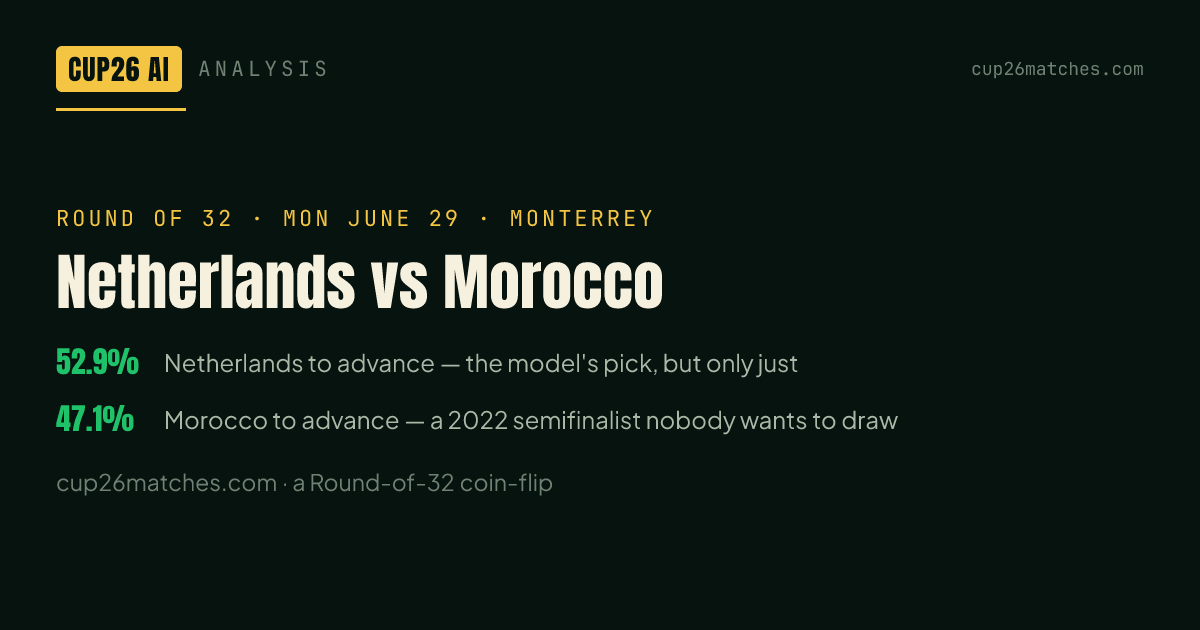
The remaining eight face, frankly, a gauntlet: Netherlands vs Morocco, Ivory Coast vs Norway, DR Congo vs England, Belgium vs Senegal, Switzerland vs Algeria, Australia vs Egypt, Argentina vs Cape Verde, Colombia vs Ghana. Five of those eight opponents are European or South American sides ranked above their African counterparts. This is where romance meets seeding.
The two runs to believe in
Our model — Elo plus Dixon-Coles, run over 50,000 Monte Carlo trials, refreshed the morning of June 29 — sorts the eight cleanly by their probability of surviving to the last 16. Two stand apart.
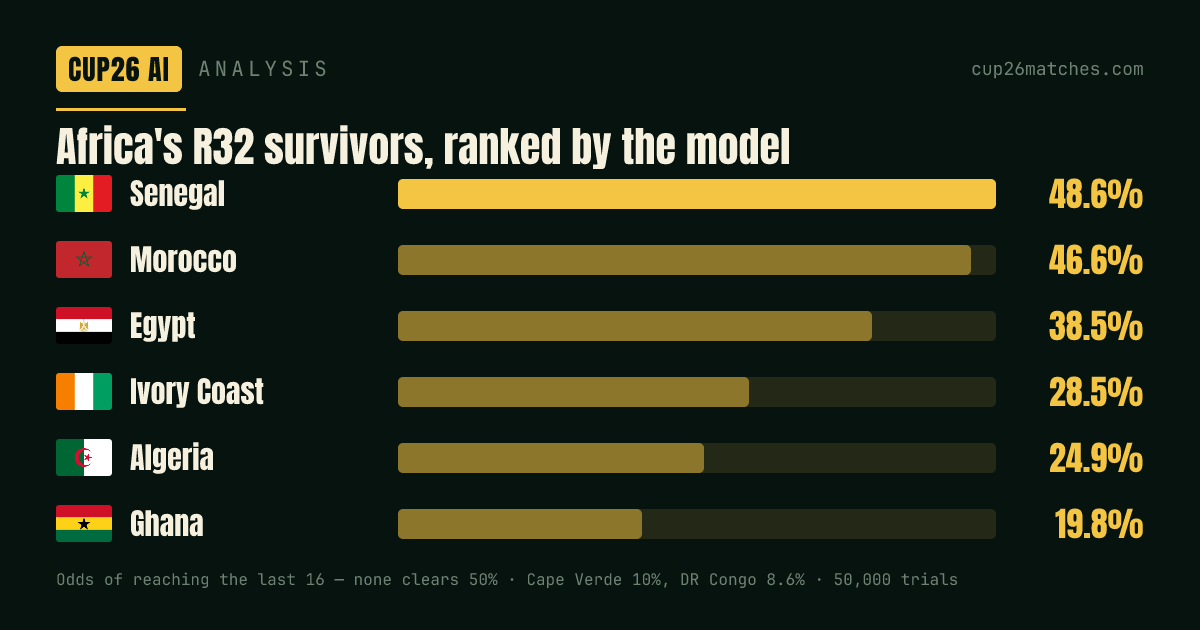
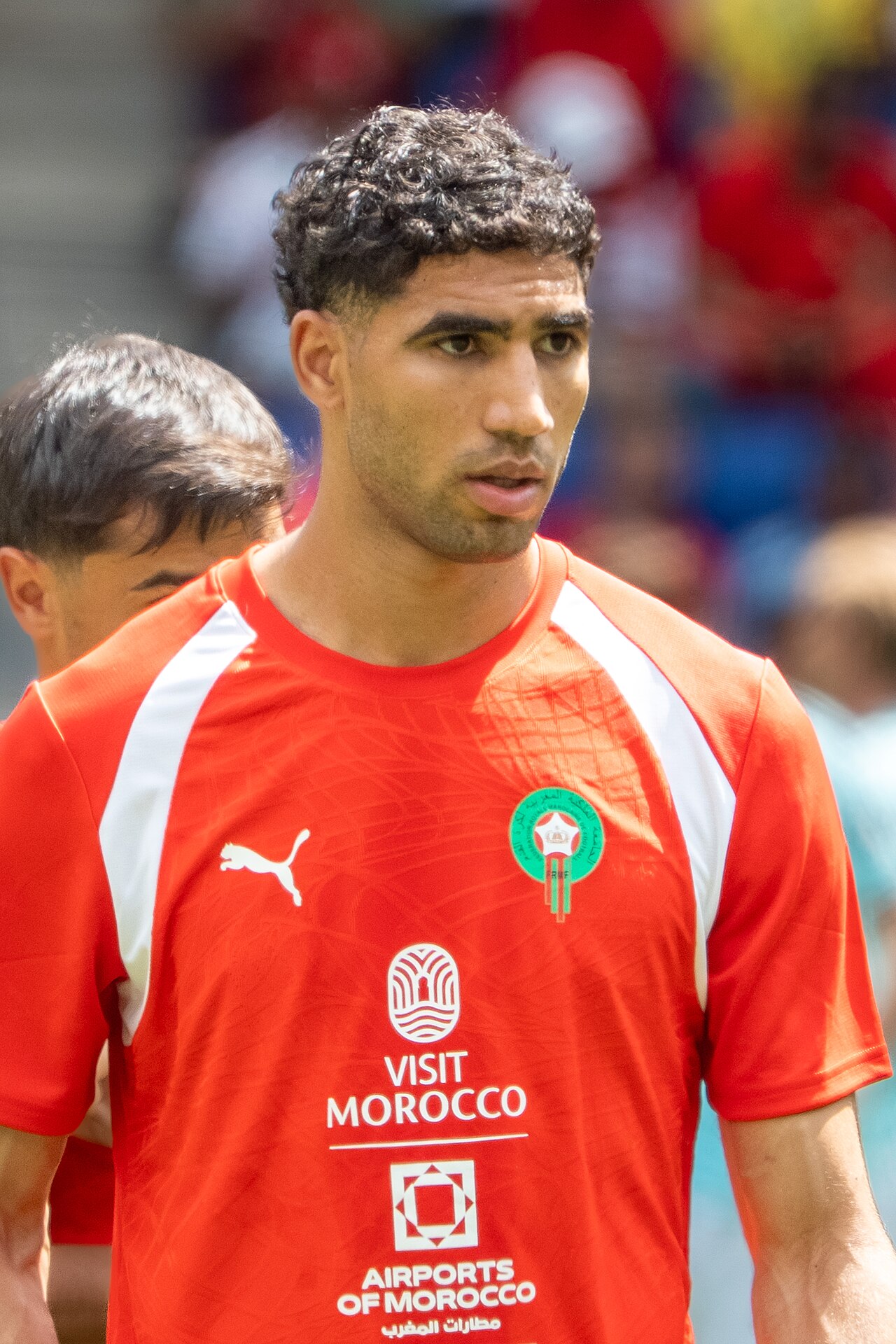
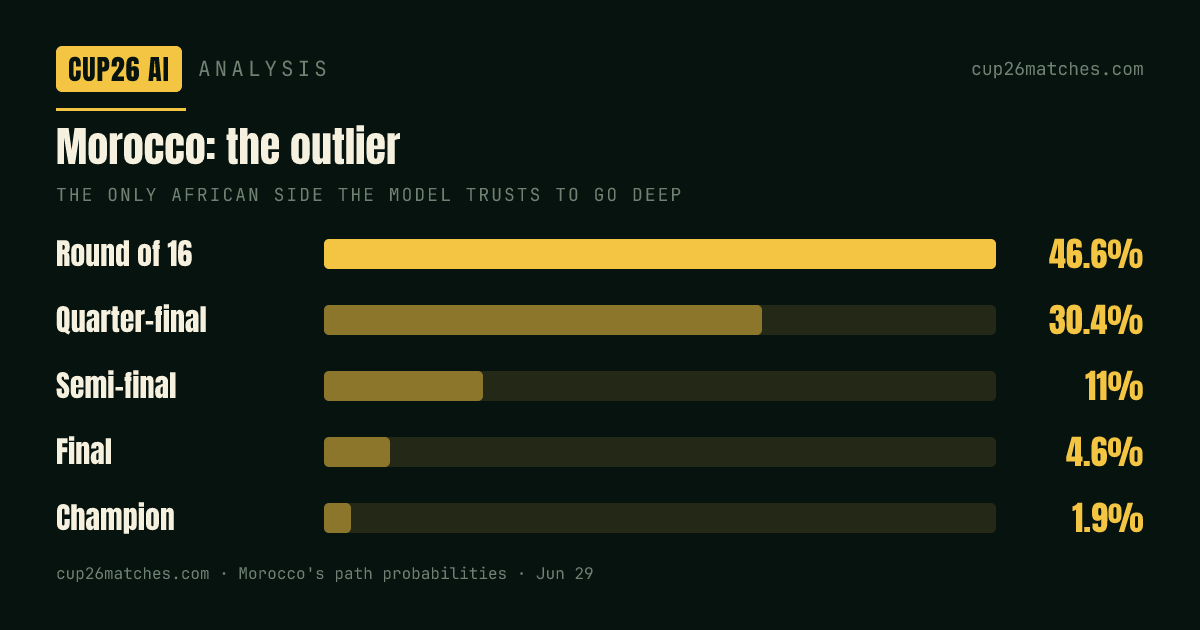
Morocco is the real deal, and it isn't subtle. The 2022 semifinalists and 2030 co-hosts finished second in Group C behind Brazil on goal difference — a 1-1 draw with Brazil, a 1-0 win over Scotland, a 4-2 win over Haiti, seven points. The model gives them a 0.466 chance of reaching the last 16 and, more tellingly, a 0.304 shot at the quarterfinals, a 0.110 semifinal probability and a 0.019 title chance. Those deep-run numbers are in a different postcode from the rest of the nine. Morocco is the only African side the model treats as a genuine threat to go far.
Senegal is the quieter surprise. On paper their draw looks worse — Belgium — yet the model hands them the single best survival number of all nine: 0.486 to reach the last 16, with a 0.249 quarterfinal chance. That is the kindest math of the group, and it comes attached to the tournament's best escape act. Senegal became the first team in World Cup history to advance from the group after losing its opening two matches, recovering from defeats to France and Norway with a 5-0 demolition of Iraq — a game tilted early when Iraq's Rebin Sulaka was sent off after a VAR check for fouling Sadio Mane — to sneak through as one of the best third-placed teams. A team that survives that does not feel like a side ready to roll over.
Note what the model does not say: it does not give anyone better than a coin flip. Senegal's 0.486 is the ceiling. Even the two runs to believe in are believe-in-spite-of, not bet-the-house.
Live, but underdogs
Three more are genuinely alive without being favorites. Egypt reached a World Cup knockout stage for the first time ever, finishing Group G runner-up unbeaten — a 1-1 draw with Belgium, a 3-1 win over New Zealand for the country's first-ever World Cup win with Salah scoring and assisting, and a 1-1 draw with Iran in Seattle. They now draw Australia, and the model gives them a 0.385 chance of reaching the last 16 — the best of this middle tier. Ivory Coast (0.285, with Norway and its Haaland-Odegaard spine standing in the way) and Algeria (0.249, facing Switzerland after a wild 3-3 with Austria steadied their group) are live underdogs — the kind of number that wins one round in four, not one in two.

The fairytales, honestly
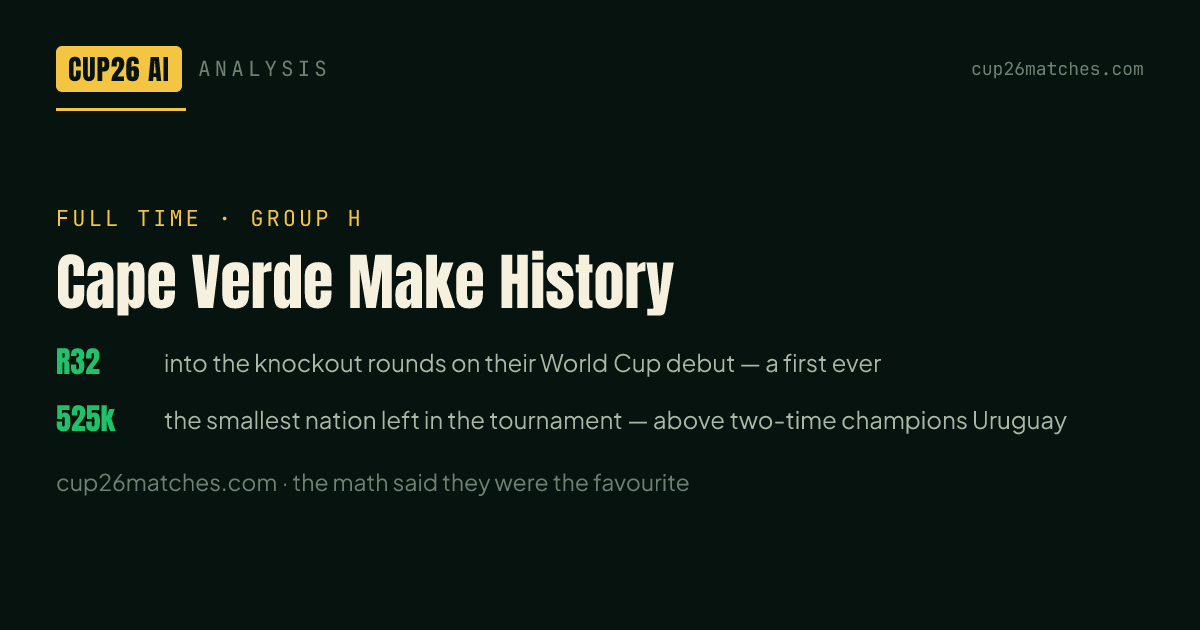
Then the stories that have carried this tournament's romance — and the model is gentle but firm about them. Cape Verde, World Cup debutants and now the smallest nation ever to reach a knockout stage at a population around 525,000, went unbeaten through Group H (0-0 Spain, 2-2 Uruguay, 0-0 Saudi Arabia) behind goalkeeper Vozinha, the first debutants to reach the knockouts since Slovakia in 2010. Their reward is Argentina. The model: 0.100 to reach the last 16.
DR Congo's run is the most cinematic of all — a first knockout-stage appearance, a first-ever World Cup win over Uzbekistan, and the nation's first World Cup since playing as Zaire in 1974, the side infamously beaten 9-0 by Yugoslavia. Fifty-two years on, that is redemption. Forward Fiston Mayele called it "really historic for our country, Congo. It's the first win and the first knockout stage." Their reward is England. The model: 0.086. Ghana, drawn against Colombia, sits at 0.198.
These are not insults; they are odds. Magic happens — that is why we watch — but if you stack the model's eight survival probabilities, the expected number of African teams reaching the last 16 lands at roughly 2.3. Not nine. Two, maybe three.
The number that matters
It is worth saying ESPN's Ed Dove was more bullish, tipping five of the nine to win their Round of 32 ties — Morocco, Senegal, Egypt, Ivory Coast and Algeria through, with England, Argentina, Colombia and Canada ending the other four fairytales. Reasonable people will disagree on the middle three. Where everyone converges is the top (Morocco, Senegal) and the bottom (Cape Verde, DR Congo).
So celebrate the nine. It is real, it is historic, and even a format that lets more teams through still had to be earned on the pitch. But the figure that will define this generation of African football isn't the one already in the record books. It's the one settled by Friday night — how many of these runs are still standing when the last 16 is set.
Related stories