A Nation of 525,000 Is Now the Favorite to Send Bielsa's Uruguay Home
By the cold numbers, Cape Verde aren't the romantic underdog clinging on in Group H — they're the favorite to take the second knockout spot ahead of a two-time world champion.

When Kevin Pina stood over a free kick about 30 yards from goal in the 21st minute against Uruguay on June 21, Cape Verde had never scored at a World Cup. Seconds later they had — and the framing that has followed the islanders all tournament, the plucky debutant nation of half a million punching above its weight, kicked in again. It's a lovely story. It's also the wrong story.
Here is the harder, more interesting truth heading into the final round of Group H matches on June 26: Cape Verde are not hanging on. They are the favorite to advance. And the team they are most likely to eliminate is Marcelo Bielsa's Uruguay — a side that wears four stars (two World Cups, in 1930 and 1950, plus the FIFA-recognized Olympic titles of 1924 and 1928) and has lifted the trophy itself twice.
The math, not the heart
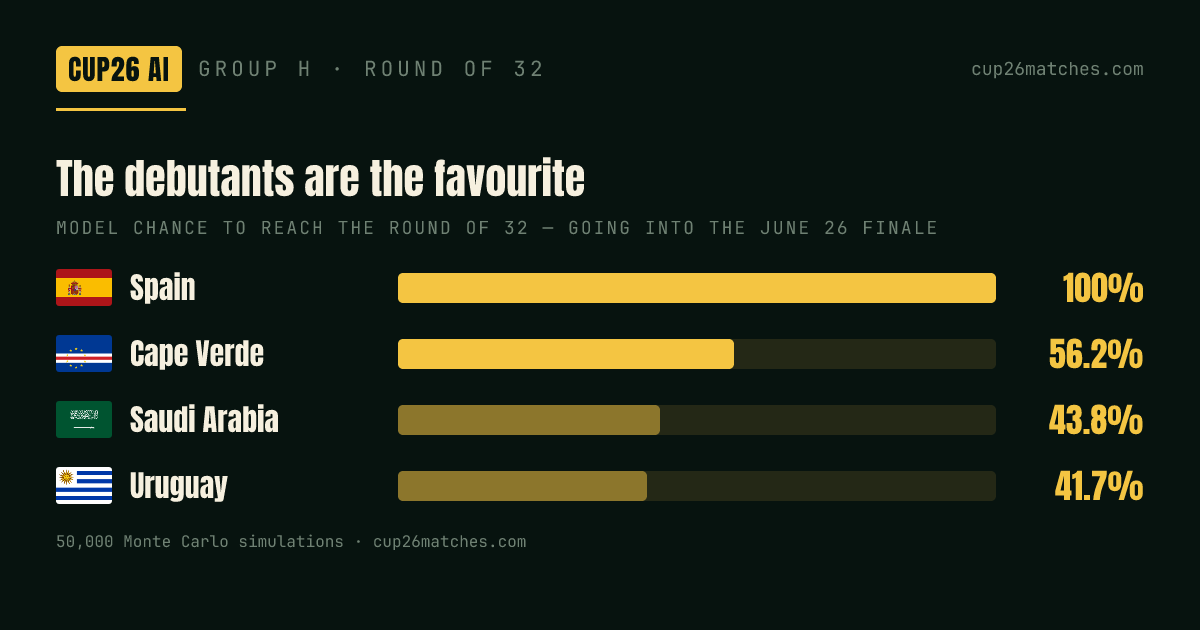
Our model — an Elo plus Dixon-Coles engine run over 50,000 Monte Carlo simulations of the rest of the tournament — puts a hard number on the upset the romance only gestures at. Going into the final matchday it gives Cape Verde a 56.2% chance of reaching the Round of 32. Uruguay sit at 41.7%. Saudi Arabia, improbably still alive, are at 43.8%. Spain, on four points, are already certain of the Round of 32 — 100% in the model.
Read that again. The debutants from an Atlantic archipelago are roughly 14.5 percentage points more likely to advance than the two-time champions. That is not a coin flip dressed up as a fairytale. That is a clear favorite.
The reason isn't magic, and it isn't even that Cape Verde have been the better team — across two games the underlying quality gap with Uruguay is real. The reason is the fixture list, and the fact that football is decided by points, not by reputation.
Why the islanders hold the better hand
The standings tell the story. After two rounds Spain lead on four points. Uruguay and Cape Verde are level on two apiece, both with two draws and identical goal differences of zero, separated only by tiebreakers. Saudi Arabia have one point and a goal difference of minus four after Spain put four past them in Atlanta.
Now look at who plays whom on the final day. Cape Verde face Saudi Arabia, the group's weakest side, in Houston. Uruguay face Spain in Zapopan, at the same time.
A win over Saudi Arabia sends Cape Verde through, full stop — five points would guarantee no worse than second. A draw very likely does it too: three points combined with a Spain win over Uruguay also secures second. So Cape Verde advance on a win or, in the most probable scenarios, a draw. Uruguay, by contrast, must avoid defeat against group leaders Spain — a four-point side that has already booked its place in the next round, and that Uruguay have never beaten in their history. One result advances the islanders; the other team needs a specific outcome against the group's strongest opponent.
That asymmetry is the whole article. A win-or-draw against the bottom side is simply a better hand than a must-not-lose date with the group leaders. The model isn't being sentimental — it's counting the paths to qualification, and Cape Verde have more of them.
Uruguay's quiet collapse
This is the part Montevideo won't want to hear. Bielsa came into this tournament without the retired Luis Suárez — the first Uruguay World Cup squad without him since 2002 — while keeping the spine of Giménez, Muslera and Valverde. The plan was control and grit. Two games in, it has produced two draws and three conceded goals.

The second of those draws was self-inflicted in the cruelest way. Uruguay watched their control of the Cape Verde game slip when Helio Varela equalised to make it 2-2 in the 61st minute. From two-time champions with a comfortable group on paper, Uruguay are now staring at the exit.
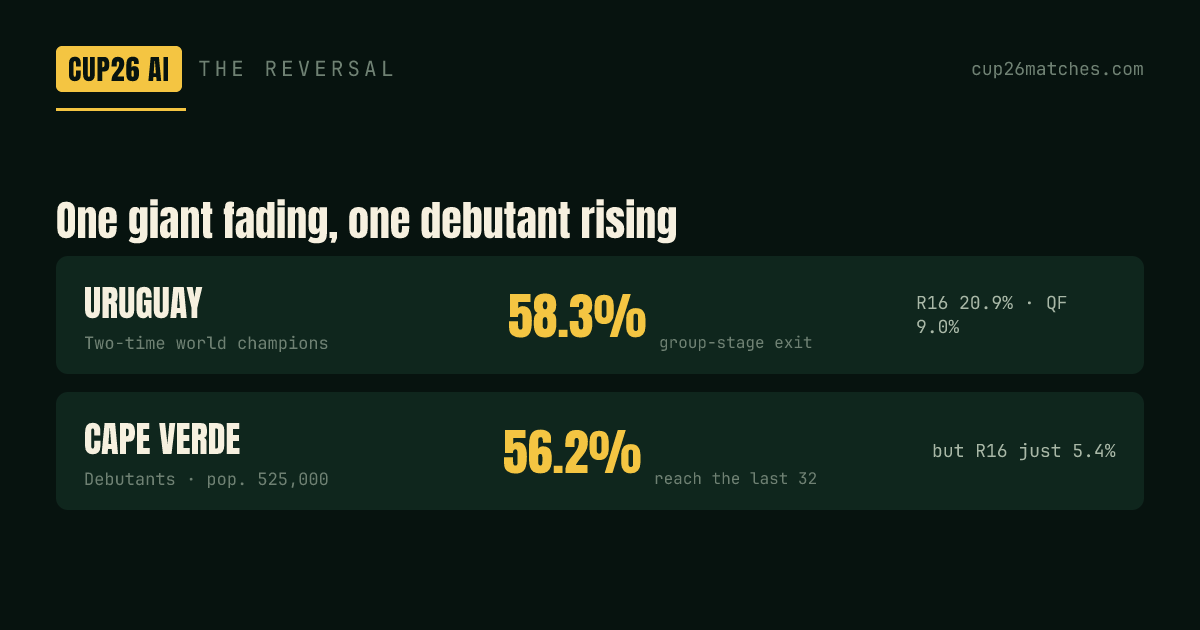
The model quantifies how thin the ceiling has become. It gives Uruguay a 58.3% chance of group-stage elimination — more likely to go home than not — with an average of 2.79 group points. Even their deeper-run odds have collapsed: a 20.9% shot at the Round of 16, 9.0% at the quarterfinals, and just a 0.5% title chance for a nation that has lifted the trophy twice.
A one-game story, told honestly
None of this means Cape Verde are about to conquer the world, and the honest version of this piece has to say so. Their tournament is, by the numbers, almost entirely a one-game story: the model gives them only a 5.4% chance of reaching the Round of 16 and a title probability that rounds to nothing (0.004%). What they are favored to do is precise and contained — win their group game, advance, and on the way knock out a giant.
And even the favorite is not a lock. Saudi Arabia's 43.8% is a reminder that a Saudi win on June 26 keeps their own qualification hopes alive and can still bump Cape Verde out; the islanders' edge is real but it is not safety. They still have to go to Houston and take care of business against a side fighting for its own survival.
That's the framing that does this team justice. Not "can the tiny nation pull off a miracle?" — but "the tiny nation is the more likely team to advance, and the math can show you exactly why." Cape Verde qualified for the first time only last October, with a 3-0 win over Eswatini, as one of the smallest and least-populated countries ever to reach a World Cup. Eight months later they walk into the final day of their debut group as favorites to survive it.
On June 26, in Houston and Zapopan, two results land at once. One of them likely sends a population of 525,000 into the knockout rounds. The other likely sends a two-time world champion home.
Related stories




18+. Please gamble responsibly.