Cape Verde, half a million people and unbeaten: the exact math putting a World Cup debutant on the brink of the knockouts
A nation smaller than most European cities has shredded the doomed-minnow script — and the permutations heading into June 26 say the romance has hard numbers behind it.

There is a lazy way to write about Cape Verde at this World Cup, and almost everyone has reached for it: the fairytale, the tiny Atlantic archipelago, the 40-year-old goalkeeper, the underdog you pat on the head before the big boys send them home. It is a lovely story. It is also, by now, slightly patronising — because the Blue Sharks are not clinging on. After two rounds in Group H they are unbeaten, level on points with two-time world champions Uruguay, and according to our model more likely to reach the Round of 32 than either Uruguay or Saudi Arabia.
That is the part the romance keeps skipping. So let's do the math.
How a debutant ended up in this position
Cape Verde arrived as one of the smallest nations ever to reach a World Cup — at 4,033 sq km, the second-smallest by land area in the tournament's history, behind only fellow 2026 debutant Curaçao (444 sq km) — and a population of around 530,000, having qualified for the first time in their history on 13 October 2025, a 3-0 win over Eswatini in Praia that sealed CAF Group D, with goals from Dailon Livramento, Willy Semedo and Stopira. The draw was unkind: Group H paired them with tournament favourites Spain, two-time champions Uruguay, and Saudi Arabia.

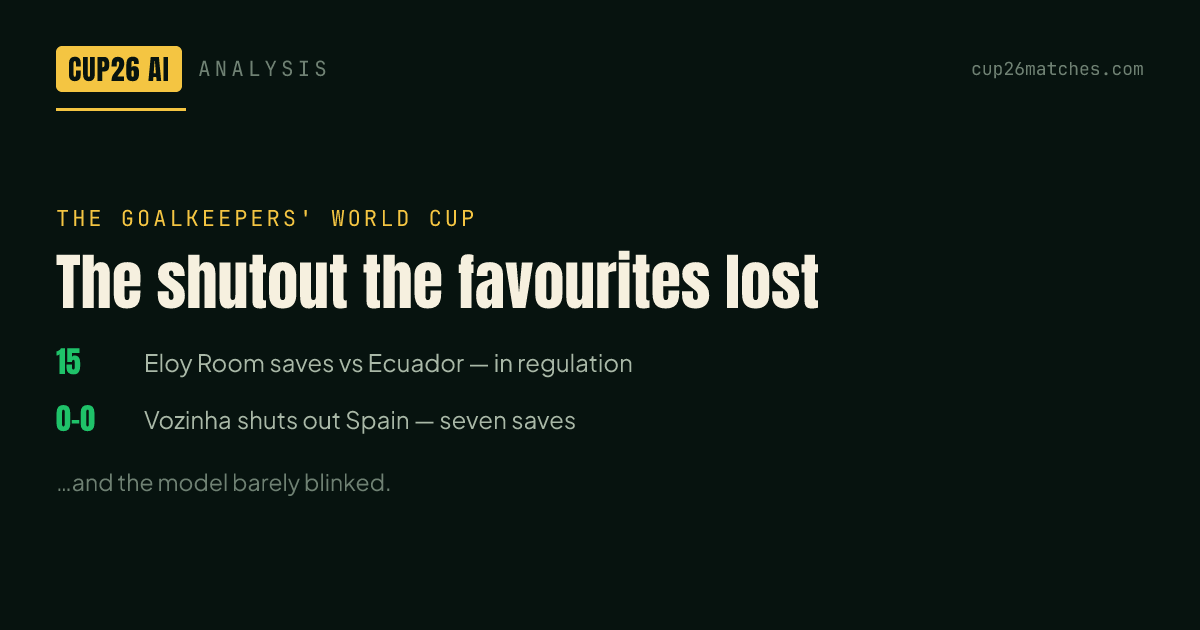
Then they refused to read the script. In their World Cup debut on 15 June in Atlanta, they held Spain to a 0-0 draw — Spain took 27 shots, seven on target, and goalkeeper Vozinha, a 40-year-old journeyman who has bounced through Portugal, Moldova, Cyprus, Angola and Slovakia, made seven saves. His Instagram following went from roughly 56,000 to about 14.2 million, helped along by Brazilian broadcaster CazeTV. A point against the favourites, and a folk hero, in ninety minutes.
On 21 June in Miami Gardens they did it again, drawing 2-2 with Uruguay. Kevin Pina opened with Cape Verde's first-ever World Cup goal — a stunning direct free-kick from 32 metres that, per Opta, made Cape Verde the first team on record (since 1966) to score their first-ever World Cup goal from a direct free-kick. Helio Varela's 61st-minute equaliser arrived 2 minutes 16 seconds into his appearance, the quickest by an African substitute at a World Cup since Roger Milla in 1994. With that, Cape Verde became the first debutant country to go unbeaten through their opening two World Cup matches since Senegal in 2002.
The underlying numbers say they rode their luck — Uruguay generated 17 shots and 2.34 expected goals to Cape Verde's 0.86 — but four shots on target and two goals is the kind of ruthlessness that wins tournaments, not just hearts.
The table, and why third place is not a death sentence
Here is Group H after two rounds:
- Spain — 4 pts (1W 1D, GD +4)
- Uruguay — 2 pts (2D, GF 3, GA 3, GD 0)
- Cape Verde — 2 pts (2D, GF 2, GA 2, GD 0)
- Saudi Arabia — 1 pt (1D 1L, GD −4)
Cape Verde sit third behind Spain and Uruguay, edged out of second only by Uruguay's superior goals scored — the two are otherwise identical, level on points and goal difference. And in the 48-team format, third place is not elimination. Twelve groups of four send their top two through, plus the eight best third-placed teams, ranked by points, then goal difference, then goals scored. Thirty-two of forty-eight survive. So a team on Cape Verde's trajectory has two routes through, not one.
Both deciders kick off on 26 June: Cape Verde face Saudi Arabia at NRG Stadium in Houston, while Uruguay meet Spain at Estadio Akron in Zapopan. Spain, on four points, are a virtual lock to advance but not yet mathematically guaranteed — if they lose to Uruguay and Cape Verde win, even they could theoretically slip to third.
The permutations, walked through

Start with the simplest line. A Cape Verde win sends them through outright — they would move to 5 points, and the worst Uruguay could do is reach 5 by beating Spain, in which case goal difference and the head-to-head context decide second, but Cape Verde could no longer finish below third and would be very hard to dislodge from a qualifying place. Beat the group's weakest side — Saudi Arabia, on one point, with a −4 goal difference, freshly thrashed 4-0 by Spain on 21 June (Lamine Yamal, two from Oyarzabal, an Al-Tambakti own goal) — and the knockouts are theirs.
The more interesting line is the draw. A draw leaves Cape Verde on 3 points with a goal difference still around zero — and a +0 or better record already beats most of the third-placed teams jostling across the other eleven groups, where plenty will scrape through on a single point or a negative differential. A draw, in other words, very probably qualifies them as one of the eight best thirds. That is the whole reason the model lands where it does.
The wildcard is Uruguay-Spain. If Uruguay lose to Spain, they stay on 2 points, and Cape Verde leapfrog them into second with any win — and even a draw would likely be enough to finish above a stationary Uruguay on the goals-scored tiebreaker they are currently losing by a whisker. Uruguay's own survival, two-time champions and all, is suddenly leaning on results they only half-control.
What our model actually says
This is where one number cuts through the noise. Our model — 50,000 Monte Carlo simulations, last run on 22 June — gives Cape Verde a 56.7% chance of reaching the Round of 32. Uruguay sit at 46.1%, Saudi Arabia at 44.2%. That is a 10.6-percentage-point edge over the two-time champions and 12.5 points over Saudi Arabia. In simulated group points, Cape Verde average 3.16, ahead of Uruguay's 2.80 and Saudi's 2.58. Spain, the group's runaway leader, project at 5.97 points and a tournament-leading 16.6% title chance.
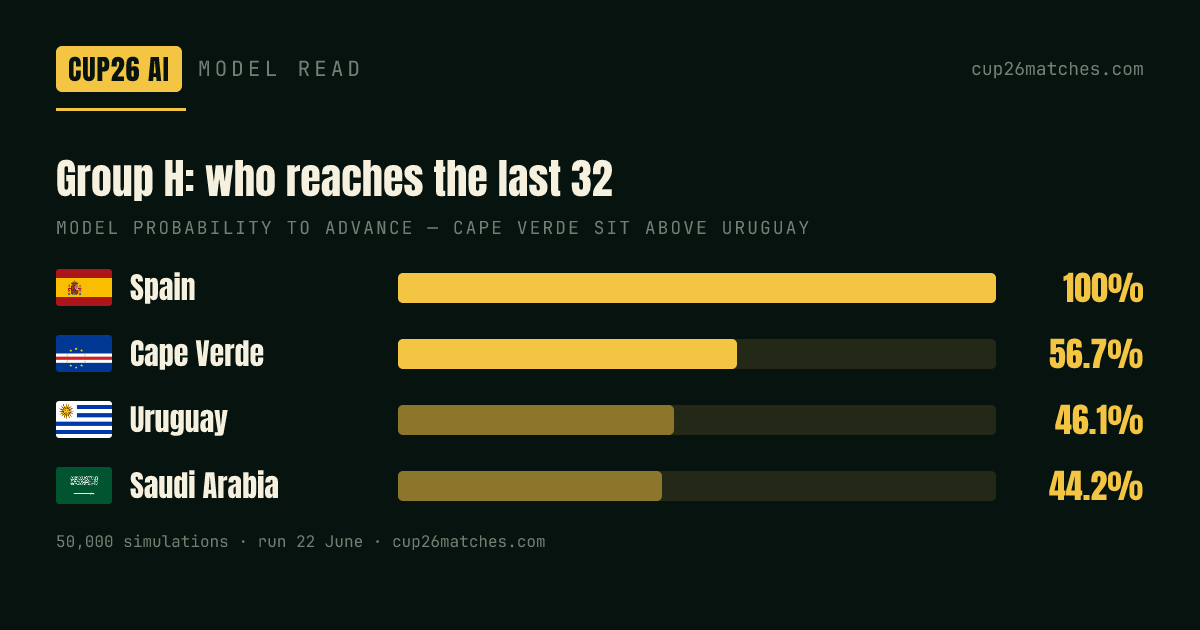
The model isn't being romantic; it's being arithmetic. Cape Verde and Uruguay are level on everything but goals scored, and Cape Verde draw the easiest closing fixture by a distance. Stack a high win probability against a battered Saudi side on top of a draw that very likely still qualifies via the best-third route, and you don't get a coin flip — you get 57-ish percent. The narrative says minnow; the math says favourite to go through.
The honest caveat
Believe in them, but with eyes open. The same model that likes their odds still has Cape Verde eliminated in about 43% of simulations — this is a strong chance, not a done deal. The best-third cutoff is a genuine lottery decided in groups they cannot influence, where a late goal somewhere across the other eleven groups could nudge the qualifying line past a drawing side. And they still have to not lose to Saudi Arabia, a side with nothing to defend and every incentive to swing. A deep run remains a long shot: the model gives them just a 7.2% chance of reaching the Round of 16.
But "win and you're in, draw and you're probably in" is the position serious teams covet, not doomed ones. On 26 June in Houston, one of the smallest countries ever to come this far gets ninety minutes to turn a fairytale into a fact — and for once, the spreadsheet is on their side.
Related stories


18+. Please gamble responsibly.