The Shutout the Favourites Lost: Inside WC2026's Accidental Goalkeepers' Tournament
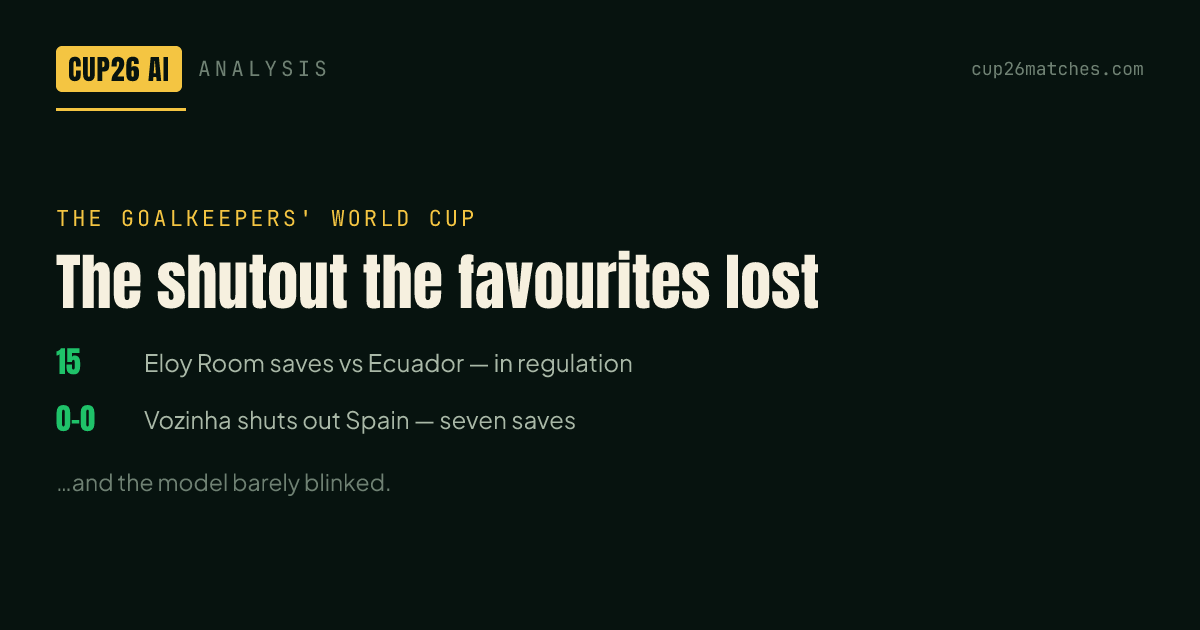
Eloy Room's 15 saves and Vozinha's tears were real history — but the data says they were variance, not a changing of the guard, and our model barely blinked.
There is a story building at this World Cup that everyone wants to tell, and it is a beautiful one. A 37-year-old who plays for Miami FC in the USL Championship stands on his head against Ecuador and matches Tim Howard's save tally. A 40-year-old, between clubs after a spell in Portugal's second division, shuts out the European champions and cries into the camera. The minnows are striking back. The goalkeepers are winning. Football is healing.
Half of that is true. The other half is the part nobody wants to print, so we will: these were not fairy-tale upsets that reshaped the tournament. They were the favourites butchering elite chances on an industrial scale — and the math says the heroes still probably go home while the wasteful giants still probably advance.
Two clean sheets, one near-record, zero goals scored — by anyone
On June 20, Ecuador and Curacao played out a 0-0 draw, and Curacao's Eloy Room made 15 saves. That equals Tim Howard's total from USA-Belgium in 2014 as logged by some providers (ESPN/StatsPerform), though FIFA and Guinness World Records officially credit Howard with 16 — so treat this as a matched tally, not a broken record. One genuine distinction does belong to Room: Howard's 16 came across a game that went to extra time, while Room's 15 came inside regulation 90 minutes. He is 37, he plays in the USL Championship, and a week earlier Germany had put seven past him in Houston, with Kai Havertz and Jamal Musiala among the scorers in a 7-1 win.
"For me as a goalkeeper, this is almost a perfect game," Room said afterwards. "I think I need a statue in Curacao now." His coach Dick Advocaat: "All you can feel is pride at how far we've come." For an island of roughly 158,000 people ranked 82nd in the world, the draw delivered its first-ever World Cup point. It is a genuinely great night.
Five days earlier, in Group H, Cape Verde's Vozinha — full name Josimar Jose Evora Dias, 40 years old, most recently with second-tier Chaves in Portugal before his contract expired in June 2026 — kept a 0-0 clean sheet against Spain. He made seven saves, denied Ferran Torres, Pedri and Aymeric Laporte, was named Player of the Match, and broke down in tears at full time. He said the tears were for his grandparents, who "did everything for me." Paul Pogba posted: "The Cape Verde goalkeeper is really something, waaaaw." His Instagram following, per Al Jazeera, jumped from around 500,000 to nearly 5 million within hours (other outlets cite even larger numbers; the figures differ, but the surge is not in doubt). At 40 years and 12 days, Vozinha was the oldest player to feature in a nation's first World Cup match.
Records, viral fame, debutant nations holding champions. The narrative writes itself.
The number the highlight reels skip
Here is what the goalkeeping romance leaves out: a save is a shot that should have been a goal. Fifteen saves is not fifteen acts of magic in a vacuum — it is fifteen chances Ecuador created and failed to finish.
The underlying numbers are brutal. Per Opta, Ecuador finished that 0-0 with an expected-goals total of 3.05 from 27 shots, against Curacao's 0.48 xG from 10. Ecuador put 15 shots on target — the highest for a CONMEBOL nation in a World Cup match since 1966. The two teams combined for 18 shots on target without scoring, also the most in a World Cup match since 1966.
Spain's night was nearly identical in shape. Sky Sports' numbers: 27 total shots, 7 on target, an xG around 2.7, 74 percent possession, 11 corners, 11 shots off target — against Cape Verde's six shots and 0.2 xG. Spain entered as roughly -1200 favourites. Their coach Luis de la Fuente was blunt: "We should have won today's match... but we lacked freshness and a clinical edge."
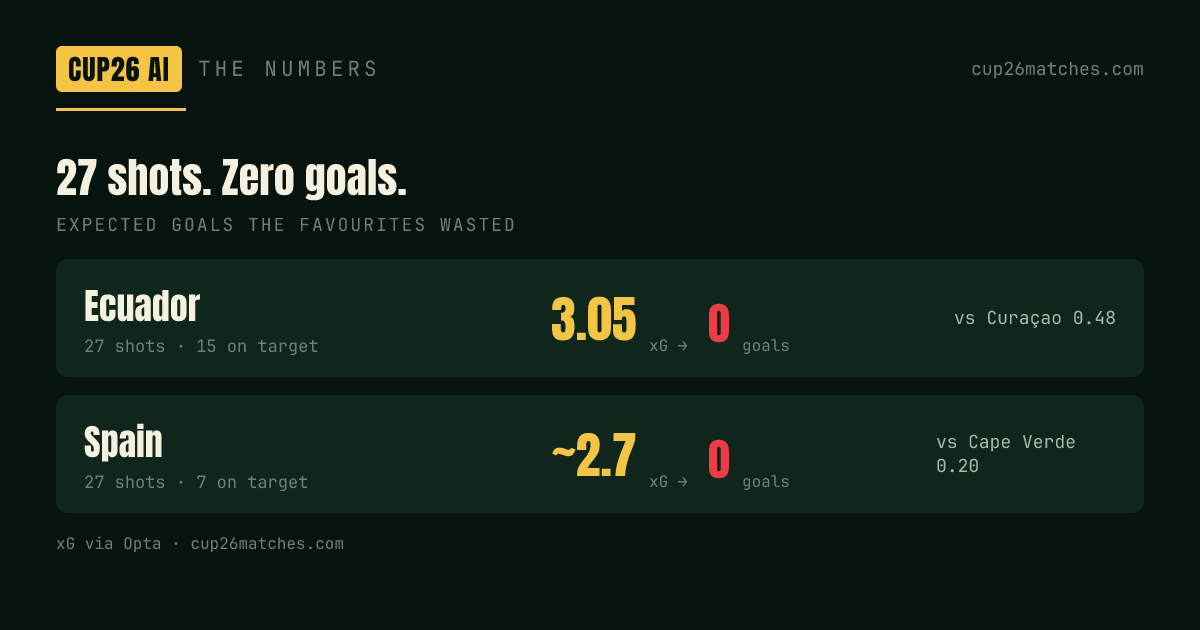
That is the real story of both matches. Yes, Room and Vozinha were superb — you do not accidentally make 15 and 7 saves at this level. But two teams generated nearly six expected goals between them across these games and converted exactly none. When you take 27 shots and score zero, the headline writes "heroic goalkeeper." The ledger writes "wasteful favourite."
Why the model barely moved
This is where our numbers do something the keeper-hero coverage cannot. Pulled live from cup26matches.com (snapshot June 21, 06:02 UTC — a few hours after the final whistle; 50,000 Monte Carlo trials; Elo plus Dixon-Coles), here is the cold read on these "shock" results.
Curacao, after the point of their lives: 18.2 percent to reach the round of 32, 81.8 percent to exit the group, an average of 1.78 group points, and effectively zero percent to win the tournament. The historic draw is a great memory and, statistically, a coin that landed on its edge.
Ecuador is the one that should stop you. The team that took 27 shots and 15 on target — the better side on the night by every attacking metric — is itself a 71.9-percent-to-go-home outfit, with 28.1 percent to advance and an average of just 2.06 group points. That is not a slight on Ecuador; it is the entire point. The model rewards points won, not xG burned, and a dominant 0-0 is worth exactly one point. Their title odds sit at 0.27 percent.
Cape Verde is the closest any of these stories comes to a real shift — and even here the model is unromantic. They land at 45.6 percent to reach the round of 32 versus 54.4 percent to exit: a genuine coin-flip, the only one of these nations the model treats as plausibly advancing, yet still more likely out than through. Spain, meanwhile, having dropped two points to a World Cup debutant, sits at 94.4 percent to reach the round of 32 and 15.2 percent to win the whole thing. A historic upset dented a title contender by almost nothing.
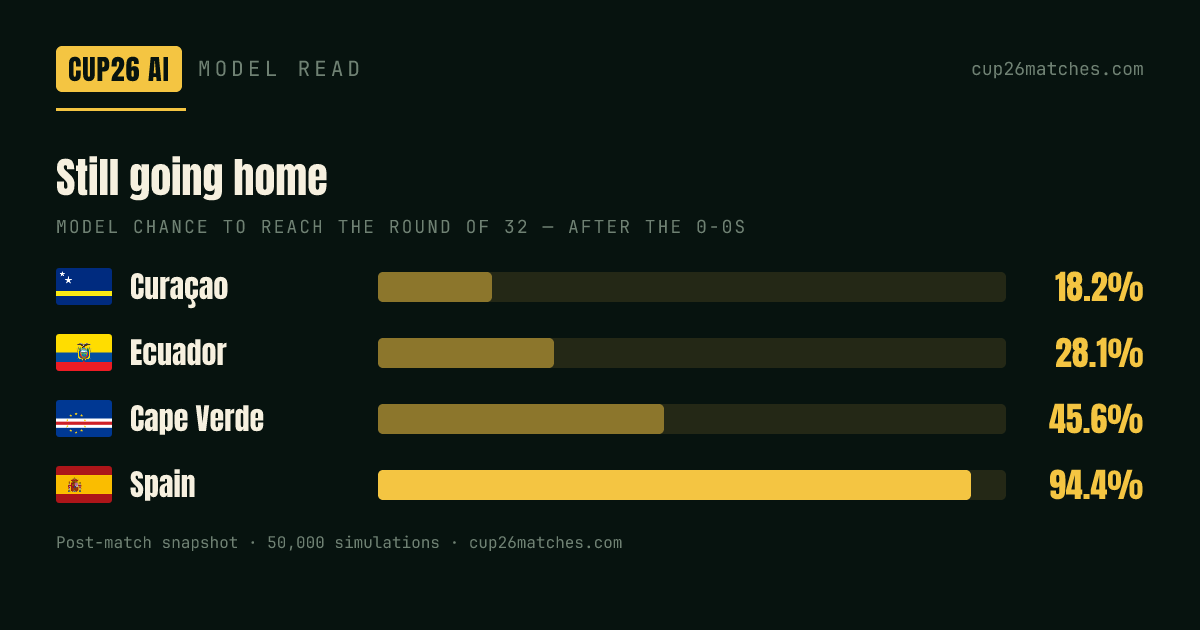
This is a genuine post-match read, not a guess at what might happen. The Ecuador-Curacao game had already finished hours before the snapshot, so these figures already digest the 0-0. The point is not that the model hadn't caught up — it had — and it still barely moved. The direction is what matters, and the direction is: nothing changed.
Variance, not a changing of the guard
So we have a genuine goalkeepers' World Cup on our hands — Room's regulation-time tally, Vozinha's over-40 clean sheet, two of the most lopsided shot maps you will see at this level. Celebrate every second of it. These were the nights of these nations' lives, and the men in gloves earned their statues and their five million followers.
But a heroic 0-0 is worth one point, and one point rarely changes a group. The story here is not that the minnows have arrived and the giants are falling. The story is variance — one wasteful night for Ecuador, one freshness-starved afternoon for Spain — bumping into two goalkeepers who picked the perfect day to be unbeatable. The favourites who sprayed 27 shapeless shots are still, by the model's read, mostly advancing. The keepers who saved their nations are still, mostly, going home.
The truer test arrives in the final round of group matches, when Curacao and Ecuador and Cape Verde need the thing a clean sheet cannot buy them: a goal of their own.
Related stories


18+. Please gamble responsibly.