Messi Owns the World Cup's Scoring Record. He Still Doesn't Own the Favourite's Tag
A missed penalty, two goals and a 12-year-old record fell in one night in Argentina's win over Austria — but the trophy math says the harder question is only just starting.

The missed penalty was the better story
For about thirty minutes on 22 June, the most decorated footballer alive was on his way to writing the wrong headline. In the 9th minute against Austria, Lionel Messi stepped up to a penalty and missed it. Not a small thing: it made him the first man to miss penalties at three different World Cups — Iceland in 2018, Poland in 2022, and now Austria in 2026 — and left him with both the most penalties missed (3) and the most taken (7) in World Cup history.
That is the part casual highlight reels will skip, and it shouldn't be. The miss is what makes the rest of the night mean something. Greatness that never wobbles is just a stat line. Greatness that misses from twelve yards in the ninth minute of a do-or-die group game, at 38 years old, and then goes and bends the entire tournament back into shape — that's a player, not a logo.
Two goals, twelve years, one record
Messi scored his 17th World Cup goal in the 38th minute, the strike that finally took him past Miroslav Klose's all-time men's record of 16. Klose's mark had stood since 2014, twelve years untouched, the kind of number that starts to feel permanent. Messi had already equalled it with a hat-trick against Algeria on 16 June; against Austria he broke it, and then kept going, adding an 18th in stoppage time to win the game 2-0.
Eighteen World Cup goals. Five of them in this tournament alone — and all five of Argentina's goals so far have been his, across the 3-0 win over Algeria and the 2-0 win over Austria. He has now also passed Marta's 17, which means Messi sits top of the all-time scoring charts for both the men's and women's World Cups at once.
The timing sharpens it. He was 38 years and 357 days old when he broke the record. He turns 39 on 24 June, in what everyone — including him — expects to be his final World Cup. There is no sequel being set up here. This is the last act, and he is writing it in real time.

Now the question nobody at the party is asking
So the individual argument is settled. The trophy argument is not, and that's the gap worth staring at.
Argentina have been, by a clear margin, the most convincing team of the group stage. Two games, two clean sheets, six points, top of Group J with only Jordan left to play. Defensively untouched, attacking through the best player of his generation on a personal heater. If you watched only Argentina, you'd assume they were the team to beat.
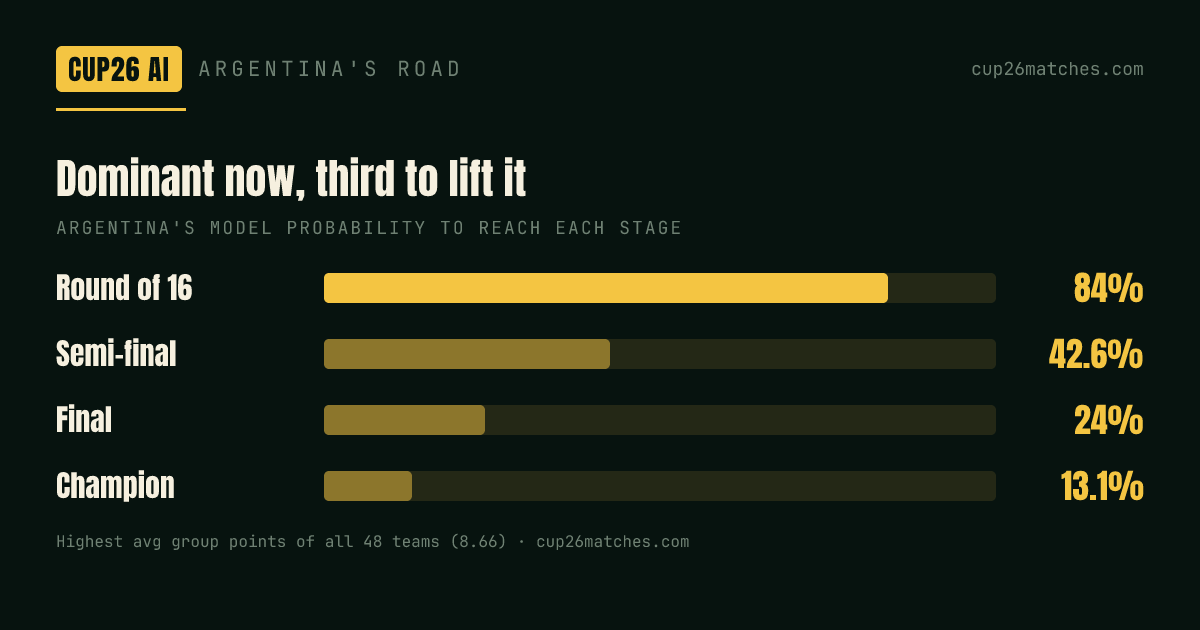
Our model — 50,000 simulated tournaments, rerun on the morning of 23 June — agrees with the first half of that and gently disagrees with the conclusion. Across all 48 teams, Argentina have the highest average group-stage points (8.66) and the highest probability of reaching the quarter-finals (63%) of anyone in the field. No team has been more dominant in the phase that's actually been played.
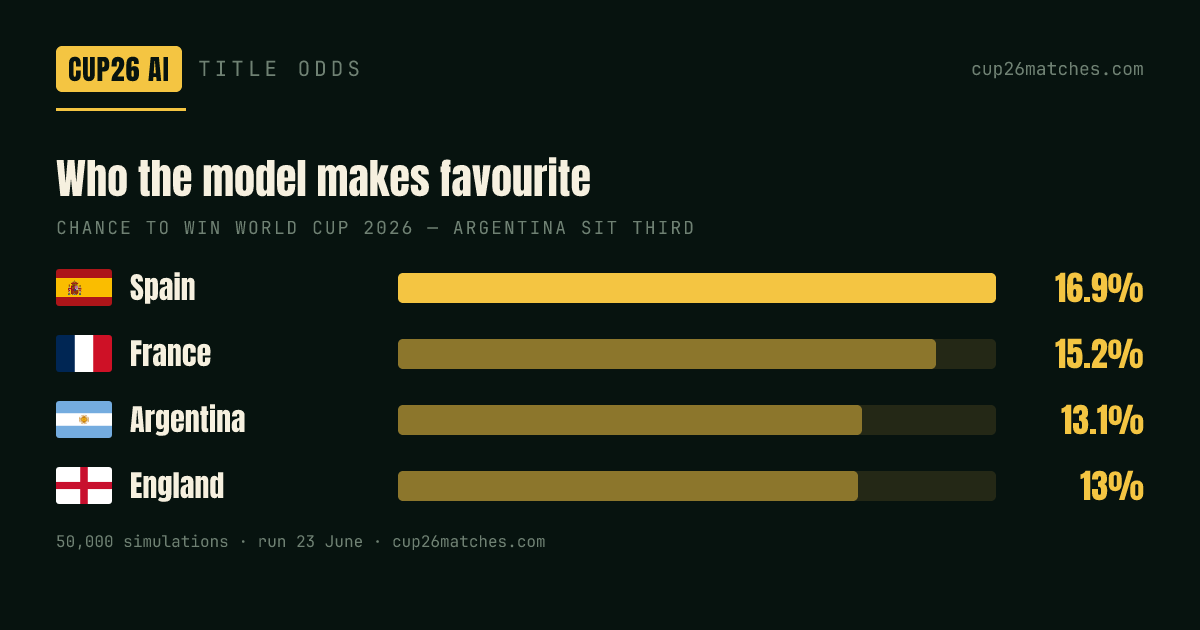
And yet they come out third to win the whole thing, at 13.1%, behind Spain (16.9%) and France (15.2%), and only a whisker clear of England (13.0%). Genuine contender — their path reads 84% to reach the round of 16, 42.6% to make a semi-final, 24% to reach the final. But not the favourite.
Why dominance now isn't the same as favouritism later
This is the part that feels like a contradiction and isn't. Being the best group-stage team and being the likeliest champion are two different questions, because they're measured over two different tournaments.
The group stage rewards what Argentina have in abundance right now: a settled side, a hot striker, and two opponents they were always likely to handle. That's why the average-points and quarter-final numbers are so high — they reflect a team very likely to win the matches in front of them over the next week.
The title is a longer, meaner road. To lift it, Argentina would have to win a knockout bracket that, from the quarter-finals on, is increasingly likely to contain Spain or France — sides the model rates as deeper, with more ways to win a single 90 minutes that doesn't bend around one man. Concentrating all five of your goals in a 38-year-old genius is electric in the group stage. Over four knockout rounds it's also a single point of failure, and the simulations price that in. Dominance is about the games you've played; favouritism is about the games you haven't.
There's also the uncomfortable thread running back to that 9th-minute miss. Knockout football, at some point, tends to come down to fine margins and, often literally, penalties — and Messi's relationship with them at this tournament is now part of the record in both directions.
The honest read
None of this dims what happened on 22 June. The record is real, it's his, and it will likely never look fragile again. A man missed a penalty, then scored twice to break a twelve-year-old record in his final World Cup — that's the rare kind of night that earns its mythology honestly, miss and all.
But the celebration and the title are separate machines. Argentina are the most dominant team of the group stage and the third-most-likely champion, simultaneously and without contradiction. Messi's individual story is finished and perfect. His team's is still wide open, and the bracket that decides it hasn't started yet.
If Jordan is dispatched as expected, the real examination begins where the records stop counting — somewhere around the quarter-finals, against the two teams the math currently trusts more than the one with the greatest goalscorer in World Cup history.
Related stories




18+. Please gamble responsibly.